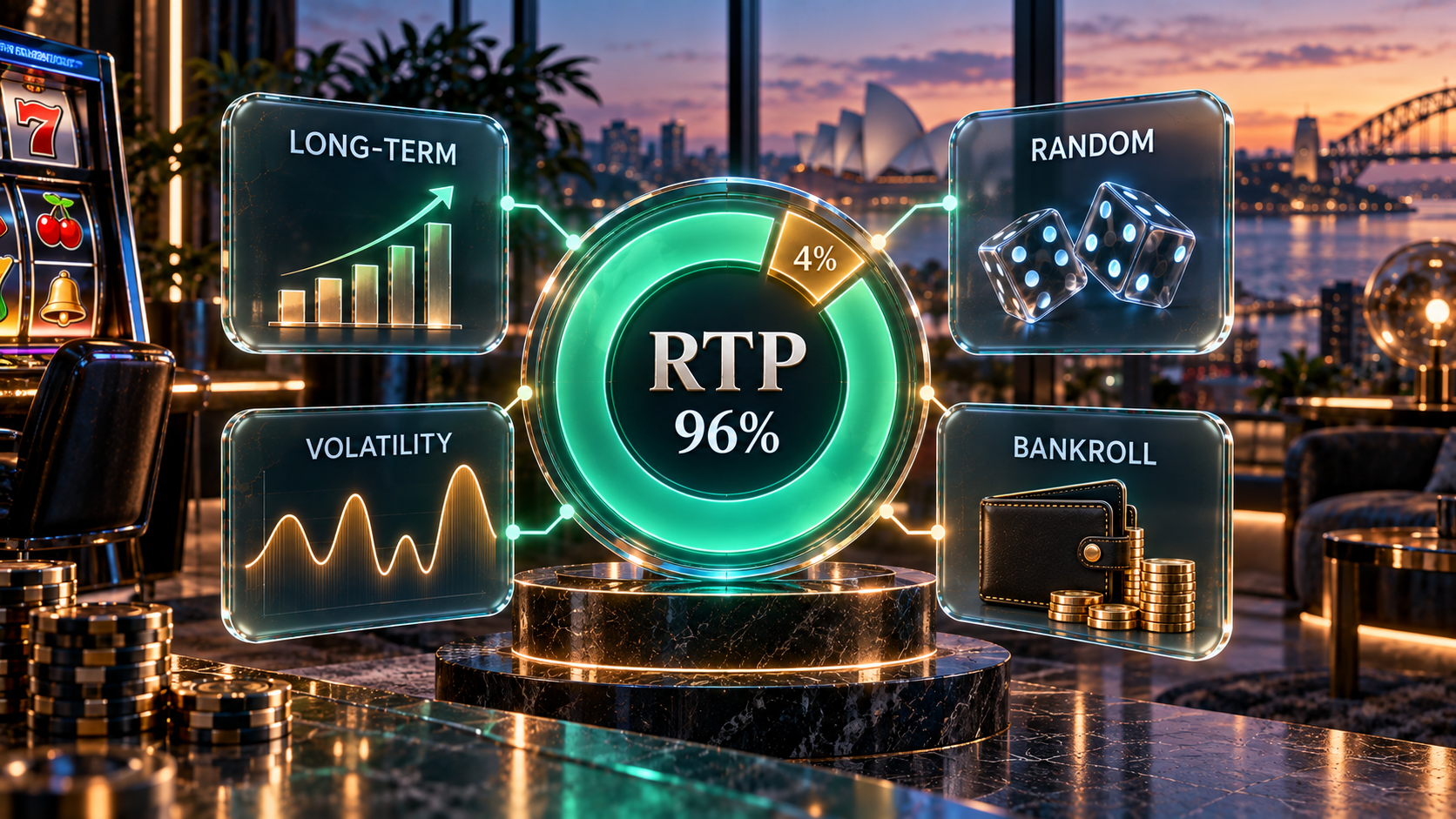
Return to player, usually shortened to RTP, is one of the most useful numbers attached to a pokie, worth understanding before getting started at an online casino. It describes the theoretical share of stakes a game returns across an enormous sample of spins, a long-run average that sits well apart from what any individual player receives in a single session. A pokie listed at 96% RTP is built to return about $96 from every $100 wagered across its full mathematical sample, and that calculation may cover millions of spins from many players. One person can finish well above the stated rate, another below it, and both results fit the same game model.
RTP is a long-run measurement
The word theoretical does a lot of work. Pokies run each spin through the game rules and random outcome process, with RTP emerging only when a vast pool of results is combined.
Imagine two games, one with 94% RTP and one with 97%. The second has a smaller theoretical edge, so it generally gives more stake back across the long run. That difference is meaningful when comparing otherwise similar games. A single session can land anywhere within that range.
A player could land a large feature early on the 94% game and leave ahead. The same player might see only small wins on the 97% game. Short results are shaped by the sequence of outcomes, while RTP describes the average built into the game over an enormous sample.
Turnover makes small percentages more visible
RTP applies to the total amount wagered across a session, including returns from winning spins used for later bets. This is where long sessions can change the picture. A $100 balance may support far more than $100 in turnover because wins are often used for later spins.
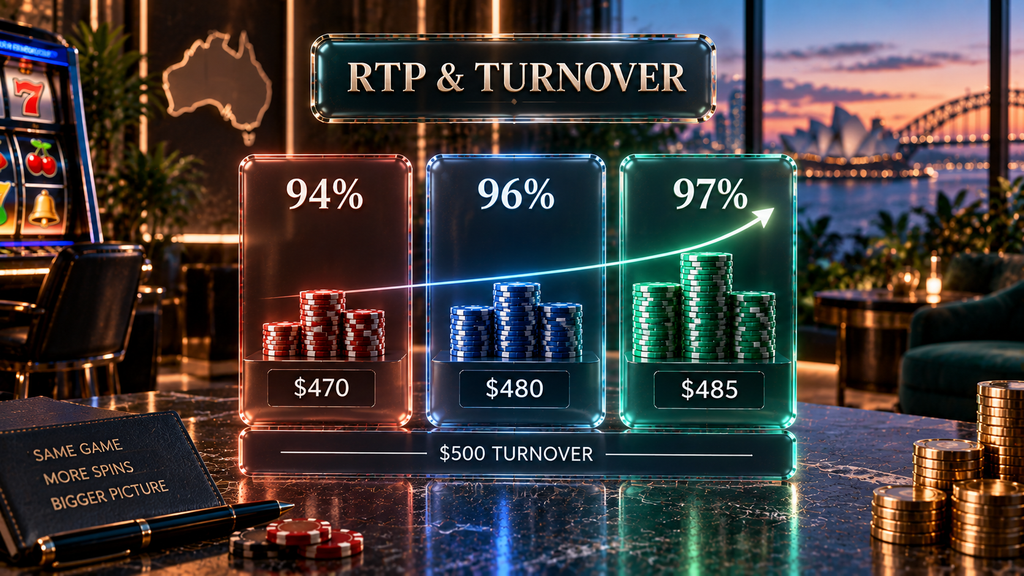
Suppose a player makes 500 spins at $1 each. Total turnover is $500, even if the opening deposit was only $100. At 96% RTP, the theoretical return on that turnover is $480, which implies a theoretical game cost of $20. At 94% RTP, the theoretical return is $470, implying $30. Real outcomes will sit somewhere around those figures, but the comparison shows why a few percentage points matter as turnover grows.
| Game RTP | Theoretical return on $500 turnover | Theoretical game cost |
| 94% | $470 | $30 |
| 96% | $480 | $20 |
| 97% | $485 | $15 |
A cleaner use of the table is comparison: it shows the underlying maths before play, independent of any session outcome.
Volatility changes how the return may arrive
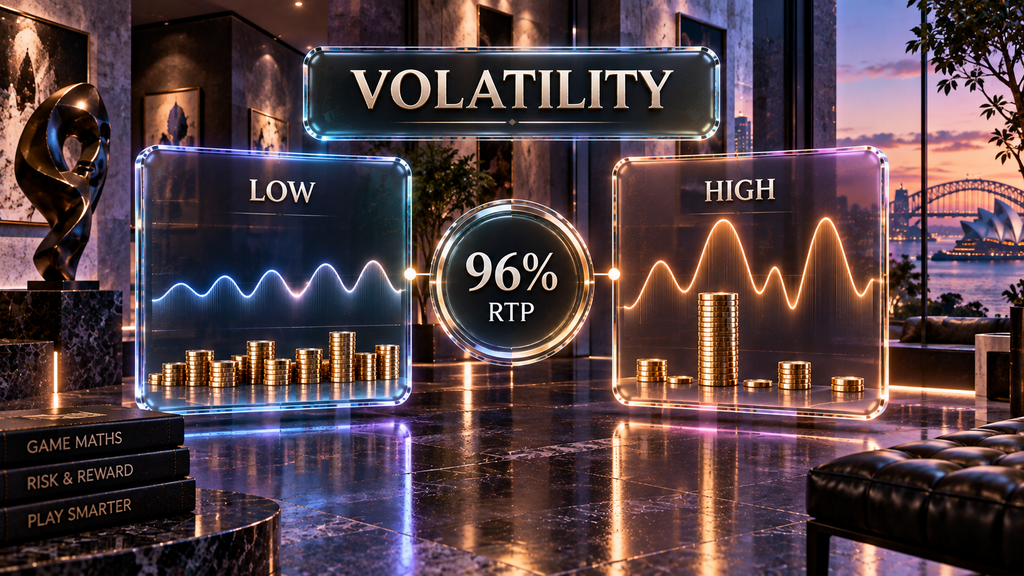
Two pokies can share the same RTP and still feel completely different. A lower-volatility title may produce smaller wins more often. A higher-volatility title may have longer quiet stretches, with a larger share of its return linked to less frequent features or prizes.
RTP answers how much is returned in theory. Volatility gives clues about how unevenly that return may be distributed. Players who focus only on RTP may be surprised when a high-volatility game moves sharply, even though its published percentage looks competitive.
It helps to read both details if they are available. A game with a pace and volatility level suited to the planned session may feel easier to manage than one selected only because its RTP is a fraction higher.
Bet size and the base percentage
Increasing the stake usually changes the dollar value of wins and losses, not the base RTP. If the game rules remain the same, a $2 spin runs on the same percentage as a 20-cent spin. It simply puts ten times as much money into each outcome.
There can be exceptions. Some games offer different RTP settings, optional features or jackpots with separate conditions. The information panel should explain if a bet level unlocks a feature or changes eligibility. Players should check the actual version presented by the operator instead of relying on a general figure found elsewhere.
A steady stake also makes session tracking clearer. Rapid changes in bet size can make it difficult to see how much turnover has accumulated and how quickly the balance is moving.
Bankroll limits matter more than chasing an average
Because RTP is measured over such a large sample, the game runs on its own mathematical model regardless of how long a session continues. Each spin is independent, with its own outcome determined by the random process. Results across any stretch reflect the randomness built into every spin.
A practical plan starts with an amount that can be spent without affecting bills or savings. The player can then choose a stake that provides a comfortable number of spins, set a time limit and decide in advance if any profit will be withdrawn or left in play.
The strongest use of RTP is comparison. It can help rule out games with noticeably weaker long-run maths. The planned budget and time limit remain the practical guide for when a session ends.
Reading the game information properly
The RTP figure may appear in the help menu, game rules or information screen. The same area can explain paylines, symbol values, feature triggers, maximum wins and jackpot conditions. Reading these details before staking gives the percentage useful context.
It is also worth checking if the displayed RTP includes bonus features and jackpots. In many games, the headline rate combines all possible outcomes. A portion of the theoretical return may therefore depend on rare events that appear across longer play.
Most pokies from established AU-facing providers sit in the 95–98% range. As a rough guide:
- NetEnt and Microgaming: typically 95.5–98%;
- Endorphina and 3 Oaks: often 95–96.5%;
- titles below 94% sit on the weaker end by industry standards;
- anything above 97% is toward the top of the range.
Players can make a short comparison note with four details: RTP, volatility, minimum stake and feature rules. That takes little time and gives a clearer picture than choosing from artwork alone.
RTP is valuable because it reveals the long-run price built into a pokie. Its limit is equally important: what the next spin or session produces stays in the hands of the random process. Used alongside volatility, turnover awareness and firm spending limits, it supports better game comparisons without creating false certainty.